
Could A Smart Test Reveal If Your Business Idea Will Work?
You’ve got an idea. Maybe it’s a membership, maybe it’s a service built around twenty-five years of experience nobody else in your field has. And you’re doing what any sensible person would do: building it properly before you show it to anyone.
That feels responsible. It might also be the most expensive habit you bring with you from a corporate career.
Here’s the part nobody tells you plainly enough when you’re facing redundancy and looking at your options. An idea that sounds reasonable to you, your partner and the three friends you’ve mentioned it to over coffee can still be completely wrong. You won’t find that out until you’ve spent months, or a chunk of your payout, building it.
If you want to test your business idea properly, there’s a cheaper way to find out. It doesn’t need a business plan, a logo, or six months of quiet preparation. It needs one honest afternoon and a willingness to ask a real person for money.
Why A Map Is Useless Without The Landscape
My background is engineering, so I tend to think about problems like a map maker. You can’t give someone reliable directions until you understand the whole landscape, not just the bit near your own front door.
Most new business ideas skip that step. We sketch a map from assumptions: this will work because it worked for someone else, because it makes sense to us, because we want it to be true.
Then we build roads across territory we’ve never walked.
I’ve written before, in other articles I have shared recently, about the gap between what sounds like a good idea and what a market will pay for. This is the practical version of that gap.
What Happened When I Knocked On Real Doors
I’ll tell you about the time I tested one of my own ideas. It didn’t go the way I’d planned, and that’s exactly why it’s worth sharing.
After following the newer AI search techniques that started appearing after ChatGPT, I thought there was a genuine opening to help local businesses apply them. So I didn’t build a course or a website first. I went round to local businesses in person and offered to help.
They said no. Fair enough, really. I wasn’t an established agency, and I had no track record to point to.
That stung more than I expected. It took the best part of a year to get my confidence back and build the basics properly, piece by piece.
Here’s the bit that matters for you, though. Those conversations were a test, not a failure, even though it felt like one at the time. I found out, cheaply and quickly, that the offer wasn’t ready, rather than discovering it eighteen months into building an agency around it.
That’s the same mechanism you need when you’re sitting at your own kitchen table weighing up what to build next. A door closing on an idea early is far better than a door closing on your savings later.
Three Things Worth Testing Before You Build Anything
You don’t need to copy my exact route into this. You need three smaller, deliberate steps to test your business idea properly.
First, find one specific problem that one specific group of people already has. Not people who want to work for themselves. Something narrower: redundant engineers trying to write a CV that explains a thirty-year career, independent tradespeople who hate doing their own quotes, retirees who want a small income without a second job.
Narrow sounds like a limitation. It isn’t. It’s what lets you speak directly to someone instead of shouting generally.
Second, build one small, deliverable promise you could keep this week. Not the whole business. One useful thing: a reviewed CV, a template, a short report, an hour of your time solving one problem well.
Third, ask real people, not your friends, whether they’d pay for it. Friends are kind. Kindness is not market research.
An opinion costs nothing. A payment costs something, and that’s exactly why it tells you the truth.
You don’t have to charge much. Even a modest sum tells you more than fifty encouraging comments ever will. Someone had the choice to keep their money and decided against it.
Being Told No Is Still Information
I want to be clear about something. If you try this and nobody pays, that is not proof you’ve failed. It’s proof you’ve learned something early, when it’s still cheap to change course.
Maybe the problem isn’t painful enough yet. Maybe you’re talking to the wrong group. Maybe the price is wrong, or the promise is confusing. None of that means give up. It means adjust and ask again.
That’s a far better use of a weekend than six months of quietly polishing something nobody has asked you for.
I know this feels uncomfortable if you’ve spent decades in a world where your work was assessed by a manager behind closed doors. It’s different again when a stranger decides whether to hand over their card details in front of you. It is uncomfortable. It’s also the fastest, cheapest feedback you’ll ever get, and it’s a great deal kinder than finding out the hard way a year from now.
You don’t need to know exactly where this idea ends before you start. You need to know whether one real person will pay for the smallest version of it. Everything else, the website, the systems, the polish, can wait until you test your business idea and get a real answer.
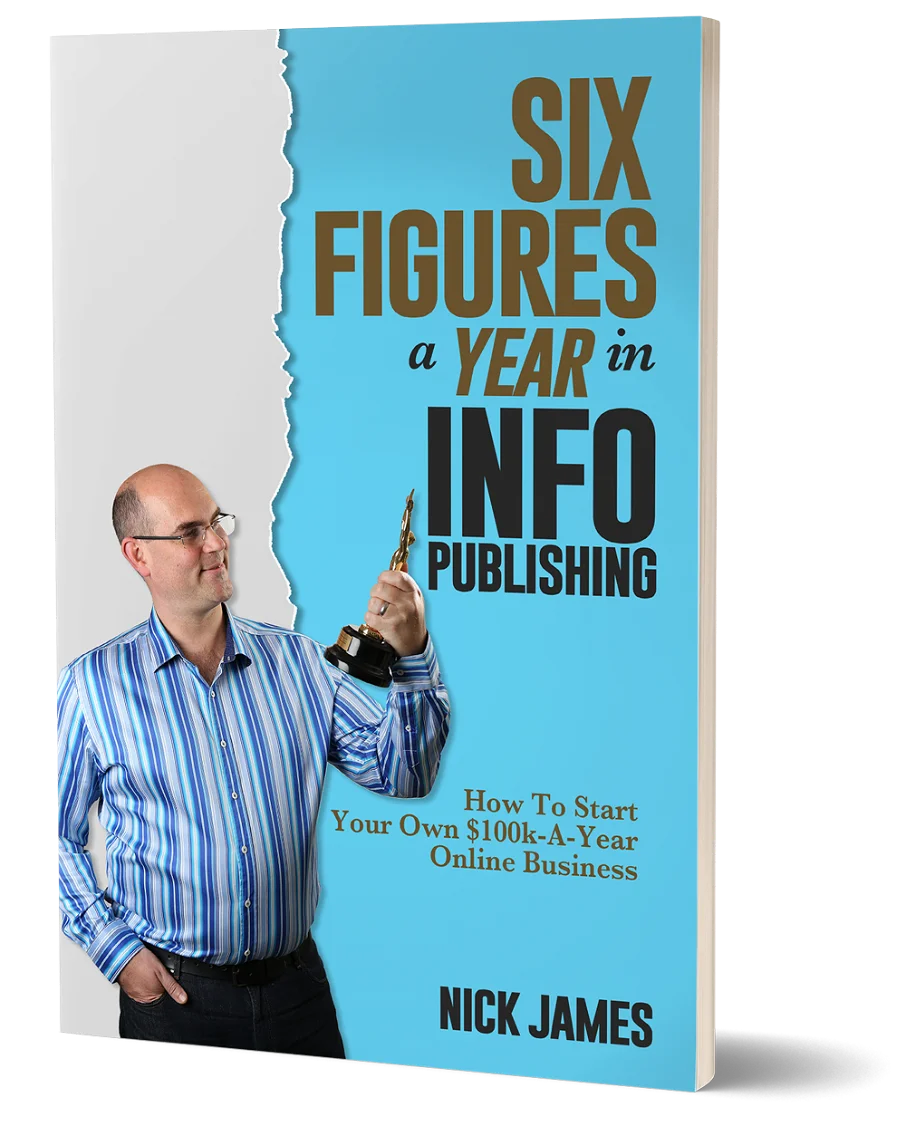
Author offers a FREE copy of this book to his next door neighbor... to prove he's not a drug dealer!
Now claim your FREE COPY.
and follow the step-by-step instructions for making the kind of money (and living the kind of lifestyle) that'll get your neighbors curtains twitching with curiosity!
Enter your details below to discover how to claim your FREE COPY of 'Six Figures A Year In Info Publishing' ...
Privacy Policy : We value your privacy. You can unsubscribe from receiving future emails with 1 click at any time.