The Hidden Test That Reveals Whether AI Knows You Exist
Would your ideal customer find you if they asked ChatGPT instead of Google? Most business owners have never tested this, and the honest answer often surprises them.
If you are fifty-plus and building something of your own after years in a career that has just ended, or is clearly ending, this matters. It matters more than you might think.
You are not just competing with other websites any more. You are competing to be the answer a machine gives, before a person ever sees your name.
I spent twenty-five years as a Chartered Mechanical Engineer, much of it on subsea systems where a fault you cannot see is still a fault. AI visibility works the same way. The problem is invisible until you go looking for it, and by then it may already be costing you customers you never knew existed.
Here is a simple way to check where you stand, and what to do once you know.
The Test Nobody Bothers To Run
Write down thirty questions a potential customer might type into ChatGPT or Gemini, without ever mentioning your name.
Not tell me about Digital Upskill. Something closer to what a stranger would ask: who helps redundant professionals build an online business, or what’s a realistic way for someone over fifty to replace lost income.
Split the thirty into three groups. Ten best questions. Ten problem questions. Ten comparison questions.
Then run each one through the AI tools your customers are most likely to use, and note truthfully whether you turn up at all.
Most people score far lower than they expect. That is not failure. It is simply the first accurate reading you have ever taken.
Why This Matters More For A Later-Life Business
If you left a corporate career the way I did, you already know what it feels like to be judged on a track record you cannot yet show. I went round to local businesses a while back, offering to help them with exactly these newer AI search techniques. They turned me down flat because I was not an established agency.
I later spent the best part of a year rebuilding my confidence and getting the basics right before I offered that kind of help to anyone again.
That rejection taught me something useful, in among the discomfort of it. Being invisible to the people searching for you is rarely about how good your work is. It is about whether the evidence of it exists anywhere the machine, or the customer, can find it.
My father understood a version of this decades before AI existed. He cut hair and altered uniforms for RAF Officers in his own time, properly declared through a Schedule D return. He sent most of what he earned back to Poland to help his sister look after their mother.
He had something to sell, somewhere to sell it, and someone who truly needed it. Three simple ingredients, and he had all three long before I ever needed to learn them myself.
What has changed since his day is not the principle. It is the somewhere. For him it was the Officers’ Mess. For you, increasingly, it is whatever an AI assistant decides to say about you, or say instead of you, when a stranger asks a question you could have answered.
Where AI Looks Before It Answers
When someone asks an AI tool a question, the words they typed are rarely the only search happening behind the scenes. The system often runs several related searches, sometimes called query fanouts, to gather enough to construct a proper answer.
For a typical question, it might be quietly checking for the best options, genuine reviews, direct comparisons and current pricing. Often it is pulling from places you have never published a single word.
Being invisible to the people searching for you is rarely about how good your work is.
That is the uncomfortable part.
Publishing another page on your own website that says I’m the right choice will not necessarily fix this. You need to exist in the places AI is already looking while it researches you: genuine reviews, relevant directories, useful discussions, interviews, comparisons.
I have been slowly working through some of this myself, and I have written more on the practical side of it in a few of the other articles I have shared recently. Go further than this one piece if you want to.
A Small Habit That Fixes A Lot Of This
You do not need a marketing department to close this AI visibility gap. You need a habit, run monthly, closer to the way I would check a boiler before winter rather than wait for it to fail on the coldest night.
Once you have run your thirty questions, look closely at any where a competitor appears and you do not. Ask yourself why them. Are they quoted somewhere credible?
Do they have clearer pages answering that exact question? Are other people discussing them anywhere public?
Fix the five questions closest to an actual buying decision first. Do not try to win all thirty at once. Strengthen your proof, earn a few genuine outside mentions, and make it unmistakably clear who you help and what you do.
Then run the same thirty questions again next month. Watch the number move. It rarely moves in a straight line, but it does move, provided you keep checking rather than assuming.
The Point Worth Remembering
Traditional search used to ask one question: where do I rank? AI visibility adds a second, quieter one: does the machine even know I am one of the choices, when my ideal customer asks it for help?
That is not a technical problem reserved for people with a marketing background. It is closer to reading a gauge you did not know existed, then adjusting accordingly. Most people simply never look at it.
Run your own thirty questions this week. You may find you are more visible than you feared, or considerably less. Either way, you will finally know, rather than guessing.
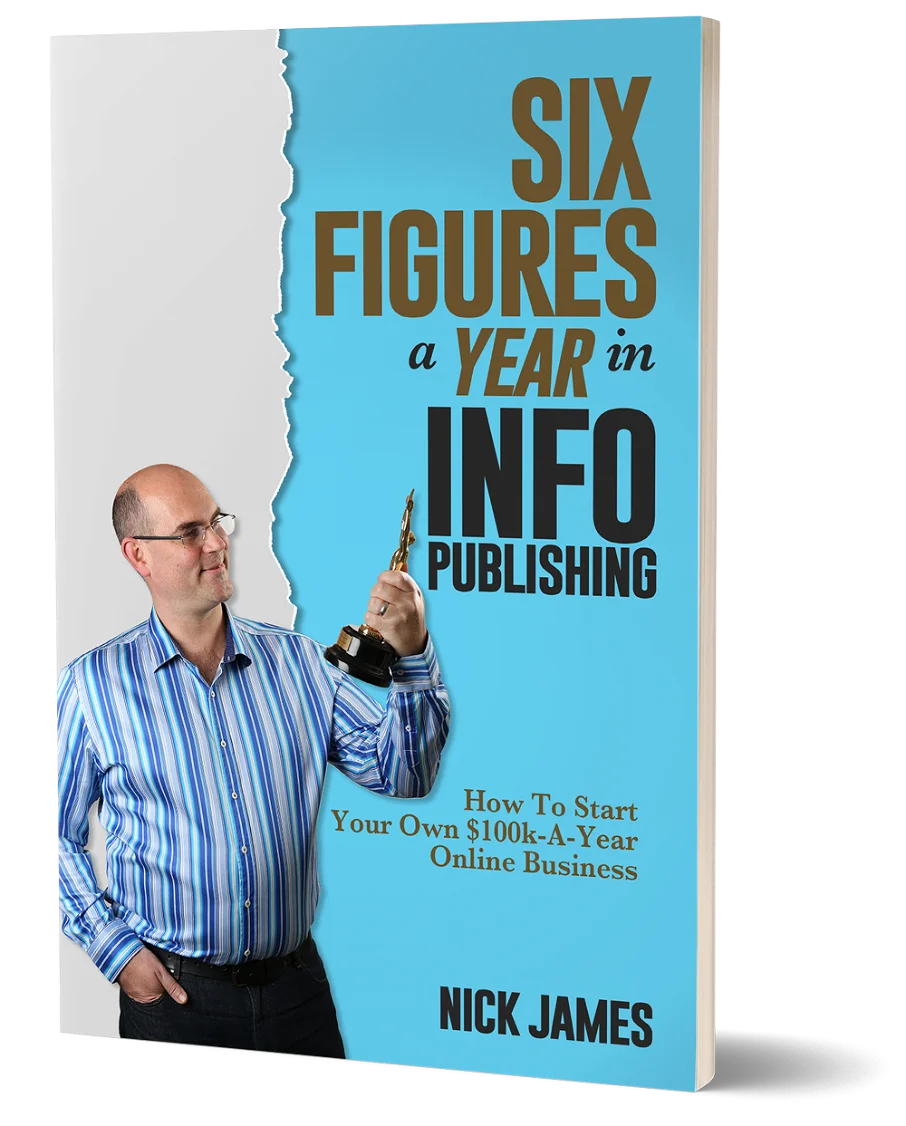
Author offers a FREE copy of this book to his next door neighbor... to prove he's not a drug dealer!
Now claim your FREE COPY.
and follow the step-by-step instructions for making the kind of money (and living the kind of lifestyle) that'll get your neighbors curtains twitching with curiosity!
Enter your details below to discover how to claim your FREE COPY of 'Six Figures A Year In Info Publishing' ...
Privacy Policy : We value your privacy. You can unsubscribe from receiving future emails with 1 click at any time.