The Honest, Simple Way To Start Building An Audience From Zero
In May 2017, with my consulting contracts gone and nothing lined up behind them, I sat in a hotel conference room in Kent for three days. I was listening to people talk about building an online business. I had no following. No email list. No idea whether any of it would work for a mechanical engineer who had spent twenty-five years in subsea systems. I had the workshop, a blank notebook, and the fact that the old way of earning a living had run out.
If you are starting an online business later in life, after redundancy or the fear of it, you have probably felt the same gap. Everyone else already seems to have an audience. You are starting with nobody watching at all.
Here is what I wish someone had told me that week in Kent. Building an audience from nothing does not require a following you do not have yet. It requires one narrow promise, one platform, and the discipline to keep going longer than feels sensible.
Stop Measuring Yourself Against Someone Else’s Following
It is easy to open a screen full of people with thousands of subscribers and conclude you have arrived too late. I did exactly that in my first year, comparing a notebook full of ideas against businesses that had been running for a decade.
That comparison is not useful. Every one of those people started with a following of one person, themselves, and a list of nobody.
The point of building your own audience is not to catch up with anyone. It is to put yourself in a position where you answer to your own decisions rather than someone else’s restructuring.
That is the whole of it, really.
Think about what that actually means day to day. It means you choose your own subject rather than taking whatever a manager assigns you.
It means failing on your own terms instead of someone else’s, which is a very different kind of failure to sit with. It means the decision to stop, change direction or keep going sits with you, not with a restructuring committee three floors away.
People who build something of their own, slowly and on purpose, end up masters of their own destiny. Corporate employment rarely allows that, however secure it looks from the inside.
Pick One Promise, Not One Topic
When I started, I thought my subject was internet marketing. It was not specific enough to mean anything to a reader.
A subject is not a reason to follow someone. A promise is.
Finish this sentence: people should read what I write because I consistently help them do, or understand, one particular thing. For a redundant engineer, that might be understanding which online business models are worth the risk and which ones only look simple. For you, it will be something specific to the gap you have noticed in your own market.
If you can write fifty different headlines under that promise without straining, it is narrow enough. It is also broad enough to keep you writing for years.
Test it against your own situation. If you spent two decades in logistics, your promise might be helping other logistics professionals spot which online business models suit someone used to supply chains and which ones do not. That one sentence, repeated in fifty different forms, is what starts building an audience out of nothing at all.
Choose One Place And Stay There
I made the mistake early on of trying to show up everywhere at once. A blog, a newsletter, and social posts, all started in the same month. Nothing got the attention it needed to work.
Pick one place where the people you want to reach already spend time, and commit to it for ninety days before judging anything. I have written about this same discipline of narrowing effort in other work, including other articles I have shared recently. It keeps proving true in different forms.
A new platform every few weeks looks like effort. It usually just resets your progress back to zero, repeatedly.
Build The Same Shape Of Content Again And Again
Random content creates a random audience, one person who liked one post and never came back. A recognisable shape creates a readership.
Pick two or three formats you can reuse with a new subject each time. A breakdown of one mistake you see repeatedly in your old industry. A short account of something that did not work for you and why. A plain explainer of one idea that confuses people new to this.
You are not inventing a new concept every week. You are producing another episode of something your reader already recognises. That is a considerable relief once you notice it, because it means the hard thinking only has to happen once.
Picture how this looks in practice. Say your format is ‘one mistake from my old industry explained simply.’ In week one you write about engineers who quote a day rate instead of a value, in week three about undercharging out of fear, in week six about talking in jargon a client has to decode.
Building an audience from nothing gets easier once a reader can predict the shape of what you will say, even while the subject changes each time. That predictability is what turns a one-off reader into someone who comes back on purpose.
Capture Your First Readers Before You Feel Ready
This is the step most people starting from nothing put off until they feel more established. It is also the one that matters most early on.
A platform lends you an audience for as long as its algorithm favours you. An email list is yours, whatever changes next on someone else’s platform.
You do not need ten thousand subscribers to start. You need a plain, specific reason for the first hundred people to hand over their address. That could be a short checklist, a simple resource, or one useful document closely tied to the promise you made in the first place.
Offer it the moment your content solves a related problem, not months later once you feel qualified to ask.
Think of the plainest version of this. A redundant engineer reading your second post is not ready to join a membership or buy a course. They are ready to trade their email address for one specific thing that solves the problem in front of them right now.
If your checklist answers the exact question your last post raised, you will capture far more of the first hundred than if you wait and build something more elaborate once you feel ready. Building an audience this way is slower than paid traffic promises, but it is yours once it is built, and nobody can restructure it away from you.
What I Would Tell That Room In Kent Now
Nobody in that workshop had an audience yet. Some of them built one by choosing a narrow promise and staying with it far longer than felt comfortable. Some gave up within a month because the following did not arrive by the second week.
Your advantage, starting later in life after a long career, is not speed. It is the judgement to know which parts of your own experience are worth sharing plainly. It is also the patience to keep showing up while an audience you cannot yet see slowly starts to notice you.
Start with one promise, one place, and one small reason for someone to give you their address. Everything else can wait until you have readers worth building it for.
I hope you found this useful
Mark
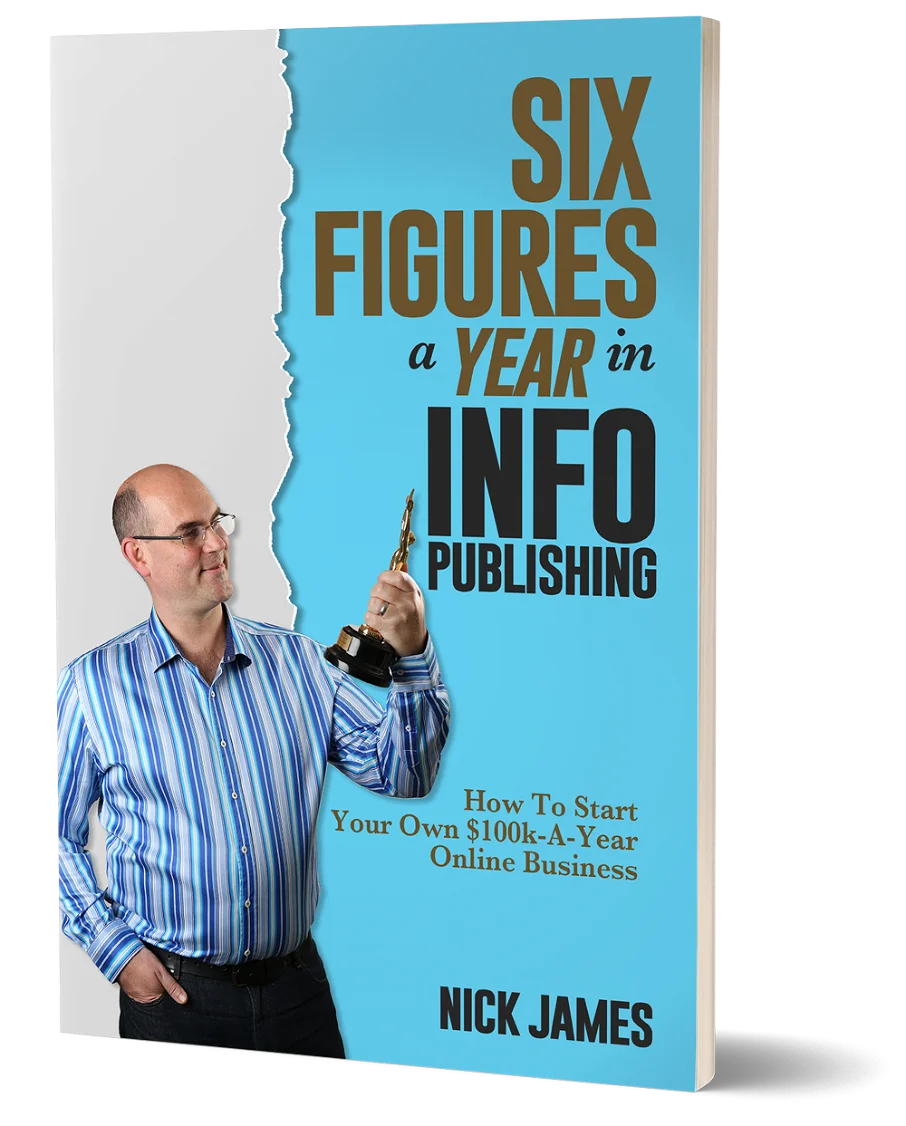
Author offers a FREE copy of this book to his next door neighbor... to prove he's not a drug dealer!
Now claim your FREE COPY.
and follow the step-by-step instructions for making the kind of money (and living the kind of lifestyle) that'll get your neighbors curtains twitching with curiosity!
Enter your details below to discover how to claim your FREE COPY of 'Six Figures A Year In Info Publishing' ...
Privacy Policy : We value your privacy. You can unsubscribe from receiving future emails with 1 click at any time.