
The Surprising Reason Your Best Content Stays Hidden
by Mark Murawiecki · September 24, 2026
You have published a dozen articles this year, and you could not tell me which one brought you a single new reader. That is not a confidence problem. It is a targeting problem, and it explains why so much good content sits there being ignored.
This is not about talent or effort. Many of the best writers I know produce something solid every single week and still can’t tell you where their last ten readers came from. The problem sits earlier than the writing itself, in what the piece is built to answer.
Most people building a business later in life, after a career that rewarded getting things right rather than getting things noticed, write about a subject rather than a question. A subject is broad, a question is specific.
Search engines, AI assistants and even short-form platforms reward the second and quietly bury the first.
If you want your next piece of writing to start getting found, this is the shift that matters more than posting frequency, better graphics or a bigger budget.
Why Nobody Finds What You Publish
When I was working with subsea control systems, nobody asked a vague question and expected a useful answer back. They asked something exact: which valve, under what pressure, in what fault condition. Precision was the whole point.
Get the pressure rating wrong and the answer was worse than useless. Someone downstream would act on it as though it were correct.
Online, most of us abandon that instinct completely. We write about starting a business after redundancy instead of the one question a reader typed somewhere last week. Something closer to “can I start an online business at fifty five with no savings”.
Try this test on your last three articles. Read each headline back and ask whether it reads like a subject heading in a textbook. Or does it read like something a worried, specific person typed into a search box?
Most of us will find at least two out of three read like the textbook, not the search box.
Publishing more content is not the same as being found by more people.
That gap between publishing and getting found is where good, honest writing quietly disappears.
One Exact Question Beats One Broad Topic
A recent piece of research into how short-form video gets discovered made a point worth borrowing, even if you never touch that particular platform. The creators who get found consistently do not build one video around a category. They build one video around one exact question, spoken plainly, reinforced in the text on screen and in the caption.
The same principle works for a blog post, a newsletter issue or a page on your site. Before you write a single word, finish this sentence: the one question this piece answers is…
Not redundancy, not starting again. Something closer to what a real, specific, worried person would type into a search box at eleven o’clock at night.
Say your reader has just been told their role is being made redundant. They are not typing ‘career change’ into a search engine at that moment. They are typing something closer to what do I do if I’m made redundant at fifty five, because that is the shape of the fear they are carrying.
Picture two versions of the same article. One is titled “How To Start Again After Redundancy”. The other is titled “Can I Start An Online Business At Fifty Five With No Savings”.
The first sounds like a chapter heading in a textbook. The second sounds like something a real, specific, worried person typed into a search box on a Tuesday night. That is exactly why it gets found while the other does not.
I think of it a bit like being a map maker. You cannot give someone useful directions until you understand the exact place they are standing, not just the country they live in.
Build A Small Cluster, Not One Lonely Post
Here is where most people stop too early. They answer one exact question, feel pleased with themselves, then move on to something entirely unrelated for the next piece.
A stronger approach is to treat that first answer as the start of a small, related cluster. If your first piece answers can I start an online business at fifty five with no savings, the next few might cover the specific worries sitting right behind it. How long it realistically takes, what the first three months look like in practice, and what to do if the first idea doesn’t work.
Suddenly you are not one lonely article competing with the entire internet. You are a small, recognisable resource on one narrow problem. That is exactly what a reader, and increasingly an AI assistant summarising an answer, is looking to find.
Six months of applying this principle compounds in a way one broad article never does. Instead of writing a fresh subject from nothing each time, you are answering the next question a trusting reader would naturally ask. The writing gets easier, not harder, because you already know exactly who you are writing for.
I learned the cost of skipping this the hard way. A few years ago I ran a test Google Ads campaign for a US health product sold through an affiliate network, with a free Health report as the lead magnet. I followed the “guru” advice and 45 people opted in.
Then nothing happened, because I had no follow-up sequence built around their specific question, only a broad topic I hoped would appeal to everyone. Zero sales followed.
In hindsight, targeting traffic was never the real problem. The lack of narrow, specific answers waiting for them was.
I have written about related pieces of this idea before, and I keep other articles I have shared recently loosely connected for that same reason. It is far more helpful to be useful on one narrow thing than impressive on twenty broad ones.
The Discipline Behind Getting Found
None of this needs new software or a bigger platform. It needs a small amount of discipline applied before you write: name the exact question, answer it properly. Then write the next piece that sits right beside it.
In practice this means three things before you open a blank page. Name the one question. Write down, in one sentence, who is asking it and why it matters to them right now.
Then check whether you have answered that exact question by the time you finish. Not a broader version of it that drifted in somewhere around the third paragraph.
It is a slower, quieter approach than chasing whatever seems to be trending this week. Trends fade quickly these days, but relevant answers persist.
A genuine, specific question asked by someone in your exact situation does not fade the same way. The situation itself keeps recurring for someone new every week.
People who leave corporate life later than most tend to want to be masters of their own destiny. That starts with being found by the people who need their skills and knowledge, not by shouting louder into a crowded room.
This is not a comfortable message if you have spent years being rewarded for volume: more reports, more meetings, more output. But a search engine and an AI assistant are not judging you on volume.
They are matching one specific question to the clearest answer available. That answer only counts if it exists in writing somewhere for them to find.
Start With The Question You Keep Hearing
You almost certainly already know the exact question worth answering first. It is the one people ask you directly, in a different form, more often than any other.
Write that one down properly this week. Answer it in full, in plain language, without wandering off into the broader subject around it. Then, while it’s still fresh in your mind write the next question that naturally follows it.
If you only do one thing after reading this, do that: write down the exact question, in the words a real person would use, before you write another sentence for anyone.
The way I think about the process is more like an FAQ, but as a structured piece not simply as a Q&A list.
It will not make you visible overnight. But it will make you findable by exactly the people you are trying to reach, which matters considerably more.
I hope you found this useful,
Mark
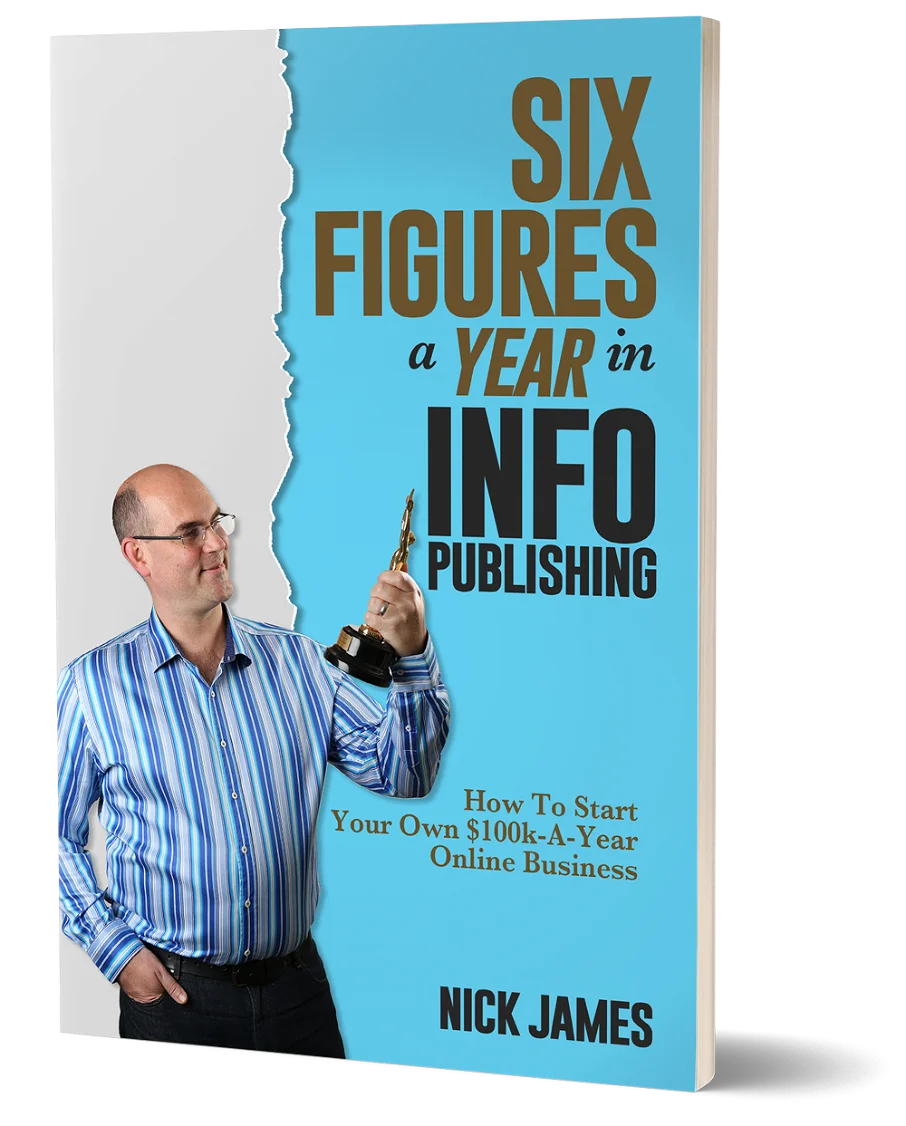
Author offers a FREE copy of this book to his next door neighbor... to prove he's not a drug dealer!
Now claim your FREE COPY.
and follow the step-by-step instructions for making the kind of money (and living the kind of lifestyle) that'll get your neighbors curtains twitching with curiosity!
Enter your details below to discover how to claim your FREE COPY of 'Six Figures A Year In Info Publishing' ...
Privacy Policy : We value your privacy. You can unsubscribe from receiving future emails with 1 click at any time.